Vitrification — ultra-rapid freezing
Vitrification
Sometimes the most important decision in a treatment is not for today; it is for the future.
In its first days an embryo sits inside a natural protective layer that shields it. To attach to the wall of the uterus at the right moment, the embryo has to emerge from that shell — a process known as hatching.
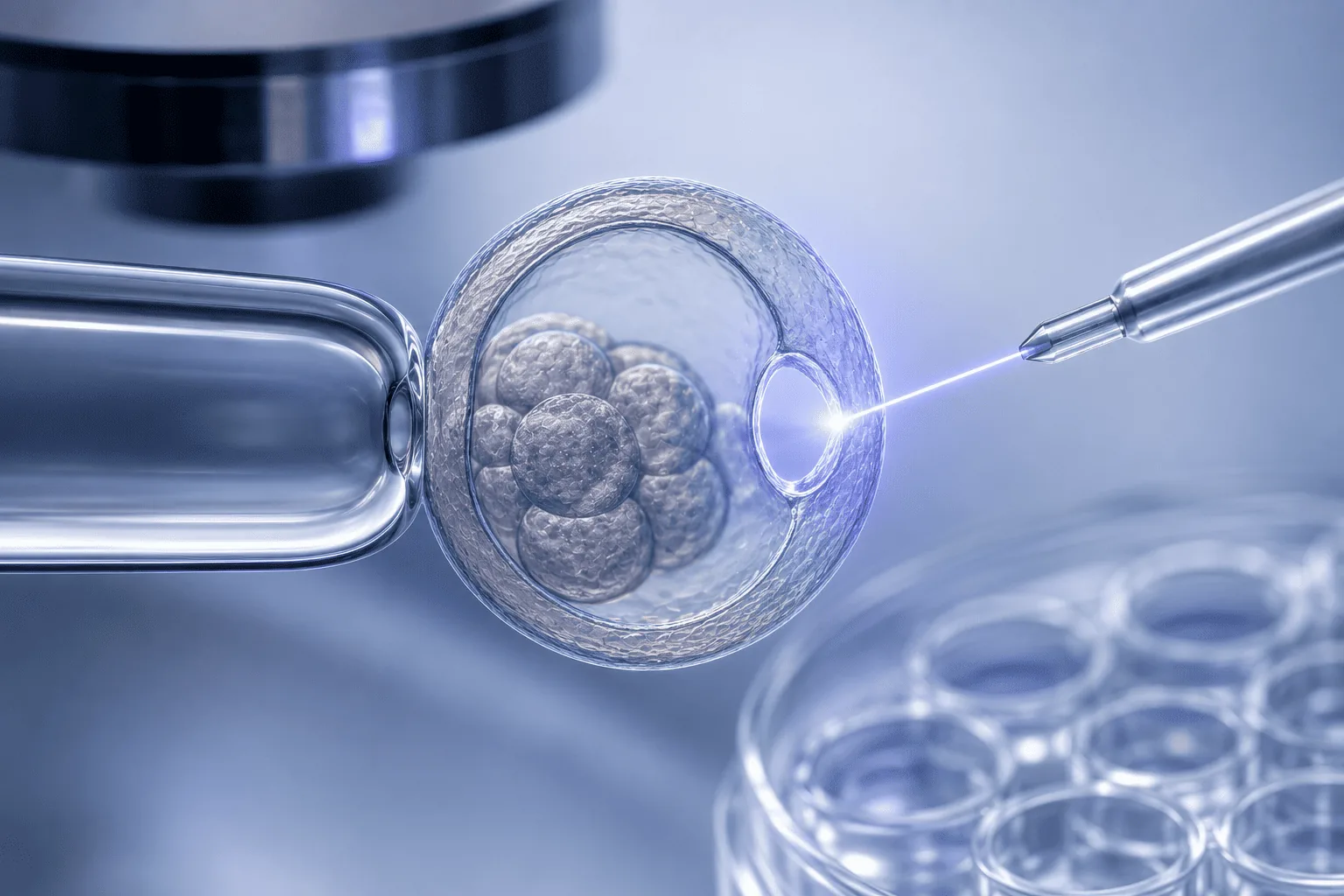
In its first days an embryo sits inside a natural protective layer that shields it. To attach to the wall of the uterus at the right moment, the embryo has to emerge from that shell — a process known as hatching.
In some circumstances a physician may judge that making a very fine opening in this layer could help the embryo emerge naturally. That procedure is called laser assisted hatching.
At Taban Fertility Center this technique is used only when, given the patient's circumstances and the clinical team's assessment, it is reasonable and useful to do so.
The procedure takes place in the embryology laboratory, before embryo transfer.
Using a specialist laboratory laser, the embryologist makes a very small, precise opening in the embryo's outer shell. It takes only a few seconds and involves no direct contact with the embryo.
The aim is not to remove the shell or to extract the embryo, but simply to create conditions in which, if needed, the embryo's natural emergence from that layer is easier.
Every stage is carried out in a controlled environment with precise equipment, so that handling of the embryo is kept to a minimum.
Laser assisted hatching is not part of routine treatment for every patient, and is suggested only in particular circumstances.
A physician may consider it in situations such as:
Some women of more advanced age
Some embryos with a thicker outer shell
Some frozen embryo transfers
Some couples with a history of several unsuccessful transfers, after a full review of their circumstances
The decision always rests on each patient's condition, the quality of the embryo and the judgement of the clinical team.
A laser makes it possible to create the opening with great precision and only at the point where it is needed.
Speed, greater control and less unnecessary handling are the chief advantages of this technology. That is why laser assisted hatching is now used as a supporting technique in many advanced fertility centres.
This is one of the questions patients ask most often.
The reality is that laser assisted hatching is not necessary for everyone, and does not produce the same result for every patient.
It is a supporting technique that in some circumstances can form part of a treatment plan. The decision to use it should therefore rest on each couple's circumstances and the physician's judgement, rather than being a fixed step for everyone.
At Taban we use this technology only where it is likely to have therapeutic value for that particular patient.
Advanced equipment is only part of the path of treatment.
What matters more is the experience of the embryologist working with it. Choosing the right moment, the position of the opening and the way the technique is carried out all depend on the knowledge, precision and skill of the laboratory team.
At Taban Fertility Center laser assisted hatching is performed with specialist equipment by experienced embryologists, so that every stage proceeds with precision, delicacy and full control.
Vitrification
Sometimes the most important decision in a treatment is not for today; it is for the future.
Micromanipulator
When the smallest details make the largest difference.
Time Lapse Incubator
Sometimes the best way to care for an embryo is to disturb it as little as possible.
The next step
An assessment before any decision. If there is a simpler path for you, that is the one we will suggest.