Vitrification — ultra-rapid freezing
Vitrification
Sometimes the most important decision in a treatment is not for today; it is for the future.
In the first days after fertilisation an embryo needs a stable, undisturbed environment. Every time it is taken out of the incubator to be examined, changes in temperature, light and surrounding conditions can affect the environment it is growing in.
In the first days after fertilisation an embryo needs a stable, undisturbed environment. Every time it is taken out of the incubator to be examined, changes in temperature, light and surrounding conditions can affect the environment it is growing in.
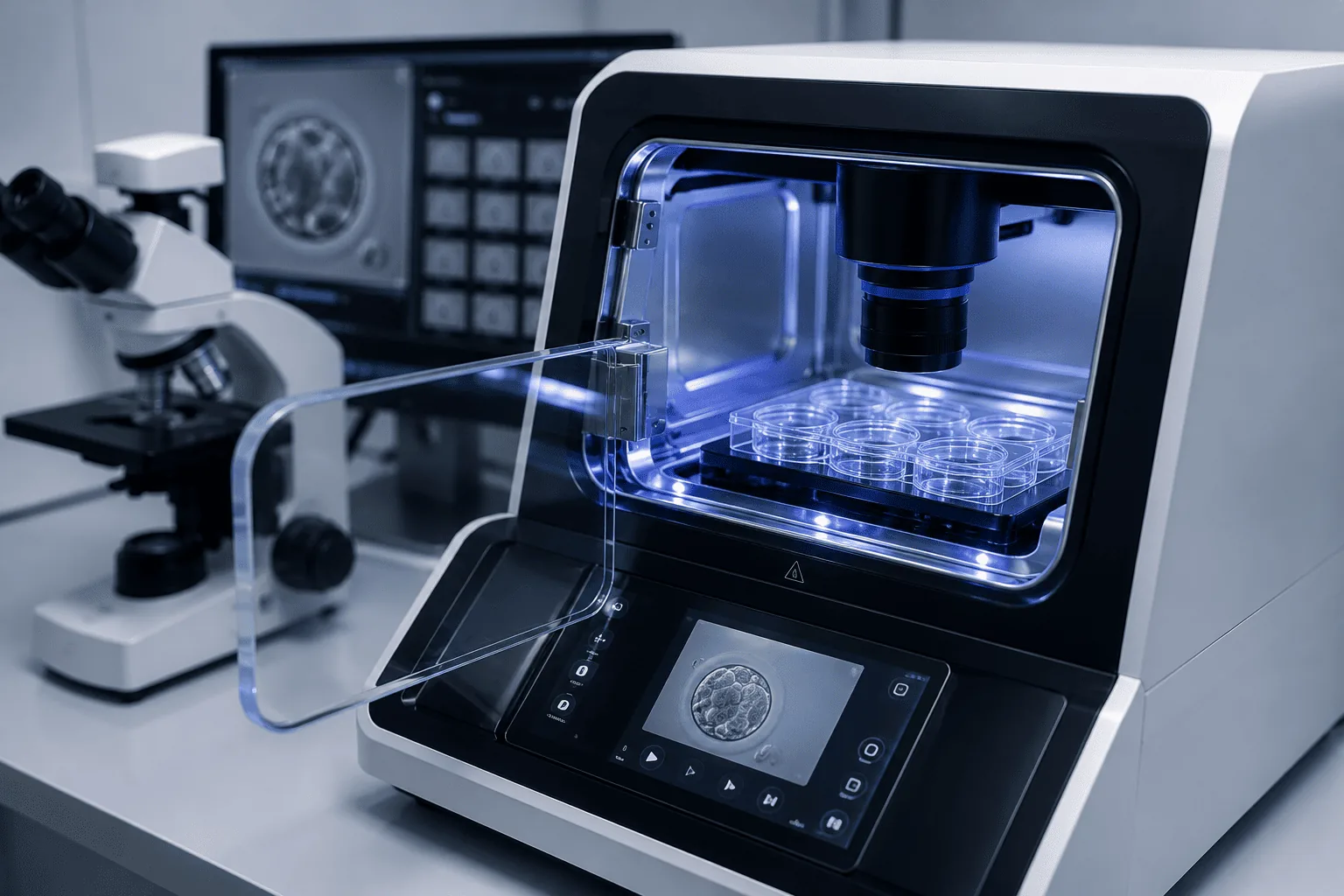
The time-lapse incubator is a newer generation of embryo incubator that makes it possible to record and review an embryo's development continuously, without removing it from its controlled environment.
At Taban Fertility Center this technology helps the embryology team follow development more closely while leaving the embryo's environment undisturbed.
Besides providing standard conditions for embryo development, the device captures very precise images at set intervals throughout that development.
Those images are assembled into a time sequence that shows cell division and embryo development from the first hours after fertilisation to the moment of transfer or freezing.
The important advantage is that following that development no longer requires taking the embryo out of the incubator again and again.
In the past, assessing an embryo meant removing it briefly from the incubator at set times so an embryologist could examine it.
Time-lapse technology allows those assessments to happen inside the same environment, and gives the clinical team more information at the same time.
The embryologist can then assess not only how an embryo looks, but how it has developed and how its cell divisions were timed.
A time-lapse incubator gives the embryology team more information, so that an embryo can be assessed more precisely.
Continuous recording helps show how an embryo changes over time, so that decisions about the treatment ahead rest on a fuller picture.
Choosing an embryo for transfer is, of course, never based on these images alone. Embryo quality, the patient's medical circumstances, the physician's judgement and other factors all take part in that decision.
No.
It is an advanced tool for monitoring and assessing an embryo more closely, but on its own it does not guarantee the success of a treatment.
Pregnancy depends on many factors: the quality of the egg and sperm, the condition of the uterus, the medical circumstances of both partners and the treatment plan.
What time-lapse does is provide more information so the clinical team can decide more precisely.
No technology can take the place of experience and scientific judgement.
Time-lapse images are valuable when they are interpreted by experienced embryologists alongside the rest of the medical picture.
At Taban Fertility Center this technology is used as a tool for assessing embryos more precisely, and the final decision always rests on a set of scientific factors and the particular circumstances of each patient.
Vitrification
Sometimes the most important decision in a treatment is not for today; it is for the future.
Laser Assisted Hatching
Sometimes a very small change completes an embryo's path.
Micromanipulator
When the smallest details make the largest difference.
The next step
An assessment before any decision. If there is a simpler path for you, that is the one we will suggest.